
Stress Evaluation of Welded Structures in ANSYS Mechanical
Written By: Paul K. Lee (Ph.D, P.Eng) and Martin Vézina (Eng, MASc)
The content in this article is for general knowledge and does not recommend any particular approach for any given application. Engineers must always critically evaluate their models and results for their application.
Welded structures are widely used in engineering applications due to their efficiency in joining complex geometries and carrying high loads. However, welds are also one of the most critical locations for fatigue failure, primarily due to stress concentrations and geometric discontinuities at the weld toe and root.
Accurate stress evaluation at these critical regions is essential for ensuring structural integrity, especially under cyclic loading conditions. Traditional nominal stress approaches often fail to capture the localized stress peaks that govern fatigue behavior. As a result, more advanced methods such as the Hot Spot Stress method (IIW), Haibach’s method, and the CAB method have been developed to provide more reliable stress assessments.
This article introduces these three widely used approaches and explains their application within ANSYS for welded structure analysis.
1. Importance of Stress Evaluation in
Welded Structures
In welded joints, fatigue cracks typically initiate at the weld toe due to:
• Geometric discontinuities
• Local stiffness variations
• Residual stresses from welding
The Challenge:
The challenge in simulation is that these local effects are highly mesh sensitive and difficult to capture directly. Therefore, structural stress evaluation methods are used to reduce mesh dependency and provide consistent fatigue assessment.
2. Methods
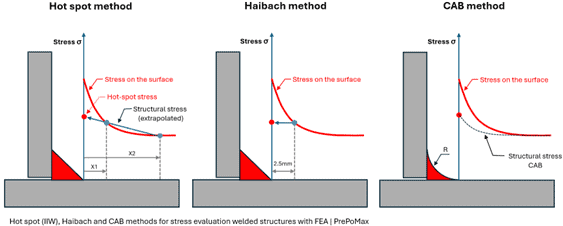
2.1 Hot Spot Stress Method (IIW):
The Hot Spot Stress method, recommended by the International Institute of Welding (IIW), is one of the most widely accepted approaches.
• Stress is evaluated at specific points near the weld toe (not directly at the notch).
• Typical evaluation points are located at distances such as 0.4t and 1.0t from the weld toe (where t is plate thickness).
• Stresses are extrapolated to the weld toe to obtain the “hot spot stress.”
• The method reduces sensitivity to local mesh refinement.
• Stress values are extracted along a path normal to the weld toe.
2.2 Haibach Method (Simplified Hot Spot Approach):
Haibach’s weld stress evaluation method is a structural hot-spot stress (SHSS) approach used in fatigue analysis to determine the stress at the weld toe, typically by evaluating the stress 2–3 mm away from the toe while excluding local notch effects.
• Stress is evaluated at a fixed distance of approximately 2–3 mm before the weld transition.
• Direct stress values are used without extrapolation.
• It is not necessary to model the exact local weld geometry, as it often leads to singularity issues.
• This method is a simplified or specific form of the hot-spot stress approach, designed to provide a more direct measurement.
2.3 CAB Method (Structural Stress Approach):
The CAB method (Chemische Apparatebau), developed at the Technical University of Dortmund (TU Dortmund), is a structural stress-based fatigue assessment approach for welded components in chemical apparatus construction. It enables the evaluation of welded joints by focusing on the structural stress (bending and membrane) while excluding the local notch effect.
• The weld geometry is idealized rather than explicitly modeled.
• The weld is replaced with an equivalent radius (where a is the weld size):
R =√2×𝑎
• The method focuses on structural stress rather than local notch stress.
• It reduces geometric complexity.
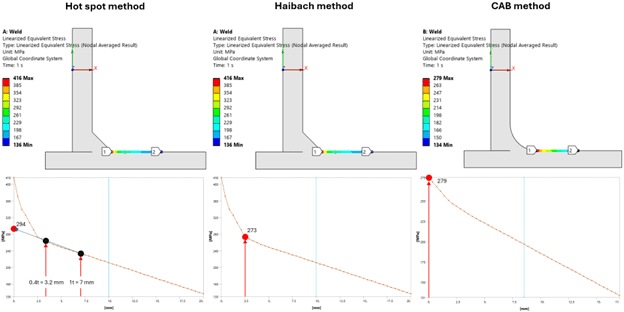
An Example of stress evaluation using the three methods
in ANSYS Mechanical
3. Conclusion
In ANSYS Mechanical, stress results can be evaluated using the Hot Spot (IIW), Haibach, and CAB methods. In addition, linearized equivalent stress can be easily extracted, enabling a straightforward and efficient evaluation of structural stresses in welded components. By utilizing these capabilities, engineers can improve the reliability of welded structure assessments and make more informed design decisions.
For more information and deeper discussions, contact our Engineering Training team.